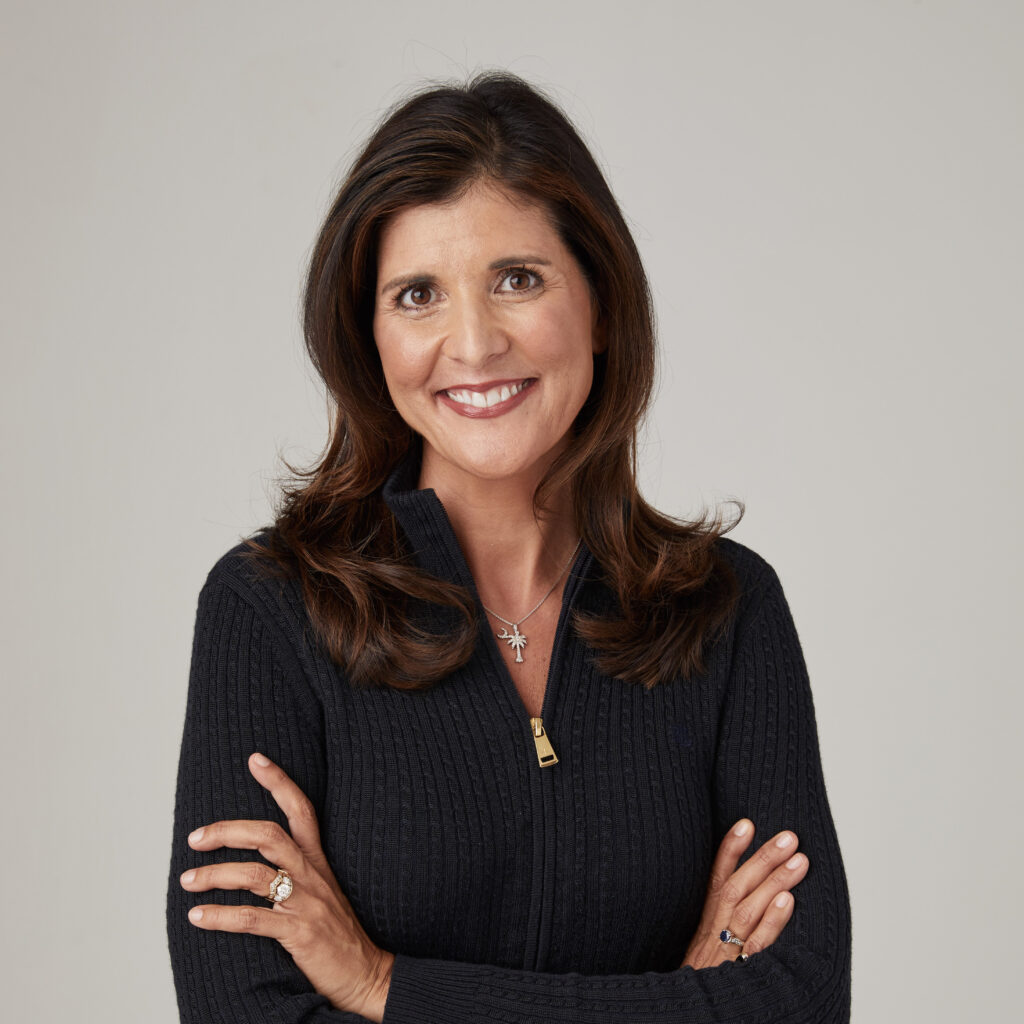
In 2010, at the age of 38, Nikki R. Haley was elected the 116th Governor of South Carolina. At the time, she was the youngest governor in the country and first female governor in state history.
As the state’s chief executive, she managed more than 67,000 state employees and balanced an annual budget of over $26 billion.
During her tenure, no South Carolina cabinet agency ran a deficit. The state also cut taxes, doubled its reserves, and reduced its debt service by half. She oversaw South Carolina’s most comprehensive government restructuring in decades, creating a single agency responsible for all executive and administrative functions, improving efficiency, and saving money.
In 2013, her husband Michael, a combat veteran, deployed to Afghanistan making her the first governor in U.S. history to have their spouse deployed. The people of South Carolina decisively reelected Haley in 2014. Two years later, Time magazine named her one of the 100 most influential people in the world.
Under her leadership, South Carolina’s economy flourished, and the Palmetto State led the nation in foreign capital investment. Haley negotiated deals with some of the largest corporations in the world — convincing them not only to build their products in South Carolina, but to call the state home. As a result, South Carolina announced jobs in all 46 counties, the state saw over $20 billion in new capital investment, its unemployment rate hit a 15-year low, and more South Carolinians were working than ever before. Known as the “Beast of the Southeast”, South Carolina had one of the fastest growing economies and manufacturing sectors in the country.
In 2016, President Donald Trump nominated Haley, then 45, as the U.S. Ambassador to the United Nations. In that role, she served as a member of the President’s Cabinet and on the National Security Council.
As ambassador, she ensured the American people saw value for their investment, defended U.S. interests, kept our country safe, and championed human rights. She prioritized reform and introduced changes to make the organization more efficient, transparent, and accountable — negotiating over $1.3 billion in savings. As a permanent member of the UN Security Council, she spearheaded negotiations with the international community that led to consensus on some of the world’s most challenging issues. For her work at the UN, Forbes named her one of the world’s 100 most powerful women.
After serving in the Trump administration, Haley founded Stand for America and Stand for America PAC. In 2024, Haley ran as a Republican candidate for president. She outlasted thirteen other candidates and became the first Republican woman to win a presidential primary.
Haley currently serves on the Board of Trustees at Clemson University and as the Walter P. Stem Chair of the Hudson Institute.
She is a two-time New York Times best-selling author for With All Due Respect and If You Want Something Done. She and her husband, Major Michael Haley, live in South Carolina and have two children.